Silent Studio
Reducing CRM Friction with AI-Powered Natural Language Operations
Built an AI-powered CRM workflow that enables natural-language data retrieval and record creation through Slack, combining LLM-driven interpretation with strict business rules to ensure accuracy, consistency, and full control — without increasing operational overhead.
2026
3 min
Corporate
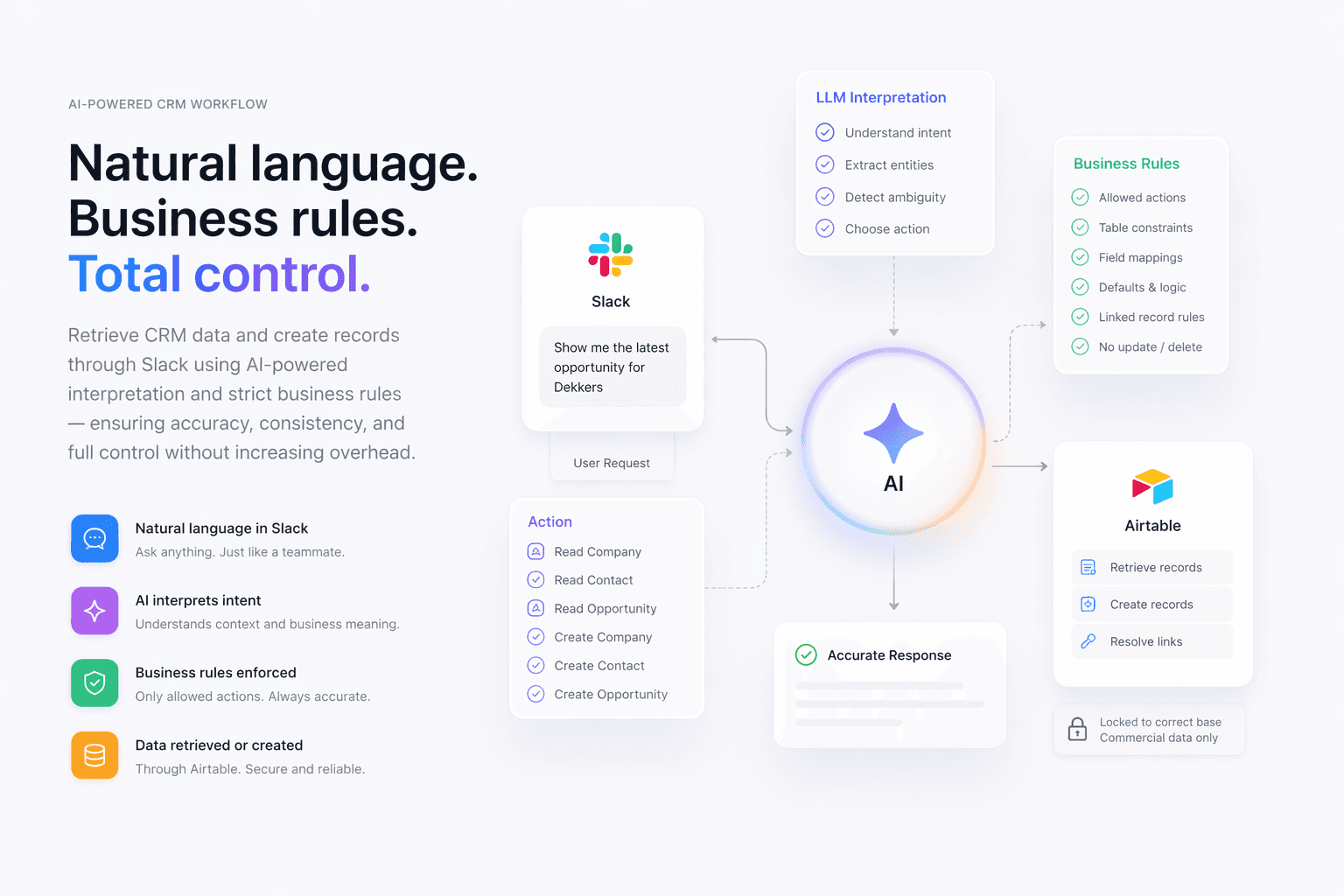
AI-Powered CRM Operations System with Business Mapping Rules
Introduction
Most AI tools can answer a question, summarize a record, or generate a reply. The real challenge begins when AI is asked to work inside a live business system.
In CRM and operations workflows, the problem is not producing text. The problem is retrieving the right information from the right place, interpreting business context correctly, and creating new records without introducing errors, ambiguity, or process drift.
We built an AI-powered CRM operations system designed for real business use rather than one-off prompting. Instead of treating the database like an open-ended chat playground, the system combines natural-language interaction in Slack, Airtable-connected execution through MCP, and strict business mapping rules that determine what the AI is allowed to do and how it should interpret requests.
The result is not “AI replacing the team.” It is a practical workflow that helps teams retrieve information faster, create records more reliably, and interact with complex business data in natural language without losing structure, control, or trust.
The Challenge
Operational systems do not usually fail because the data is missing. They fail because access to that data is inconsistent, unclear, or too dependent on manual interpretation.
The main issues were:
Business data spread across multiple related tables that were not easy to query in natural language
Users needing answers quickly without understanding underlying database structure
Weak retrieval causing the wrong records, wrong relationships, or incomplete answers
Business terminology being interpreted inconsistently across users and use cases
Record creation requiring manual navigation and field-by-field entry
Operational logic living in people’s heads instead of in a system
Growing risk of process mistakes when AI was given too much freedom without business constraints
For sales and commercial workflows, this becomes more than a convenience issue. It becomes an operational one. Without a reliable system, teams lose time, create duplicate or incomplete records, misread account context, and depend too heavily on a few people who know how the database “really works.”
Goals & Objectives
The system was built to:
Reduce time from question to reliable answer
Allow teams to retrieve CRM information in natural language
Support record creation directly from conversational input
Keep all reads and creates aligned with actual business rules
Prevent AI from operating outside approved scope
Reduce manual friction in navigating CRM structure
Make data access more scalable across team members with different levels of technical knowledge
Create a more usable interface to structured business data without sacrificing control
Our Approach
We designed the system as a controlled business workflow rather than a generic AI assistant.
Natural-Language Interface with Structured Execution
Users interact with the system through Slack using normal business language. Behind the scenes, the AI interprets intent, relevant entities, and likely business meaning. But the execution layer remains constrained by explicit rules. The AI can help understand the request, but it cannot freely invent actions or operate outside defined boundaries.
Business Mapping Rules
A central business mapping layer determines how user language maps to business objects such as companies, contacts, and opportunities. It also defines which actions are allowed, how related records should be resolved, what defaults should be applied on creation, and when the system must ask for clarification instead of guessing.
This keeps the system flexible in language but stable in execution.
Deterministic Data Access
The backend is locked to the correct Airtable base and only supports approved read and create flows. Instead of allowing open-ended autonomous database behavior, the system resolves entities step by step, validates relationships, and executes only supported operations. This reduces the chance of retrieving from the wrong source, creating records in the wrong structure, or introducing avoidable operational mistakes.
LLM-Heavy Reasoning with Operational Guardrails
The AI remains central to the experience. It handles interpretation, ambiguity, and conversational usability. But the system does not rely on the model alone. Business rules, validation logic, and constrained execution paths ensure that the intelligence of the interface does not come at the cost of reliability.
Production Use
The final workflow supported:
Natural-language CRM queries in Slack
Retrieval of company, contact, and opportunity information
Context-aware interpretation of business phrasing
Clarification flows when requests were ambiguous
Direct creation of new companies, contacts, and opportunities
Business-default handling for new records
Controlled execution through Airtable MCP
Logging and validation around every supported action
Results
In early use, the system delivered clear gains in usability, speed, and operational consistency.
Metric | Before | After | Change |
|---|---|---|---|
Time to retrieve common CRM information | several minutes of manual navigation | under 1 minute through Slack | significantly faster |
Friction for creating new records | manual table navigation and field entry | conversational create flow | major reduction |
Consistency of data access | dependent on user knowledge | guided by business mapping rules | significantly improved |
Risk of misinterpreting business requests | high in manual or loosely prompted flows | reduced through constrained interpretation | major improvement |
Reliance on internal CRM experts | high | reduced through natural-language access | materially improved |
AI execution safety | weak in open-ended agent flows | rule-constrained and limited to supported actions | substantially improved |
Key Wins
CRM access became a usable operational workflow rather than a specialist task
Teams could query structured business data in natural language without needing to understand the schema deeply
AI remained flexible in understanding intent while business rules protected execution quality
Record creation became faster and easier without opening the door to uncontrolled changes
Related records could be resolved more reliably instead of guessed from vague text matches
The system became easier to trust because it was designed to clarify when uncertain rather than acting with false confidence
Business logic moved out of people’s heads and into a reusable operational layer
Final Outcome
The project moved from a fragile AI-access layer into a structured business operations system. Instead of treating the CRM as a generic chat target, the workflow made it possible to retrieve and create records through a controlled, business-aware interface.
This was not a generic AI assistant connected to a database. It was a practical system for interacting with operational data through natural language while preserving structure, accuracy, and business control. For teams managing commercial workflows, that makes AI far more useful as part of a real operational process rather than a novelty layer on top of existing tools.
If you want, I can also turn this into a more polished website case study version with stronger marketing language and clearer “business value” framing.